
Acumatica Review 2026: Pros, Cons, and Fit
In today’s ultra-competitive digital marketplace, businesses aren’t just wondering if digital transformation is necessary, they know it is. Thriving small and medium-sized businesses are the heart of the modern economy, and to stay competitive, you need tools that empower every person to innovate and collaborate.
That’s why so many organizations are turning to modern technology, specifically ERP software, to centralize, automate, and streamline operations. The goal? To become a viable, profitable company now and in the future.
Unfortunately, finding the “right” ERP can be challenging. How can you know with certainty which ERP solution will provide everything you need at a price that makes sense?
To help you navigate this decision, we’ve compiled this comprehensive Acumatica ERP solution review. We’ll cover feedback from real customers, independent analysis, and the Acumatica software reviews that will help you determine if this solution fits your unique needs.
What is Acumatica ERP and Who Is It Built For?
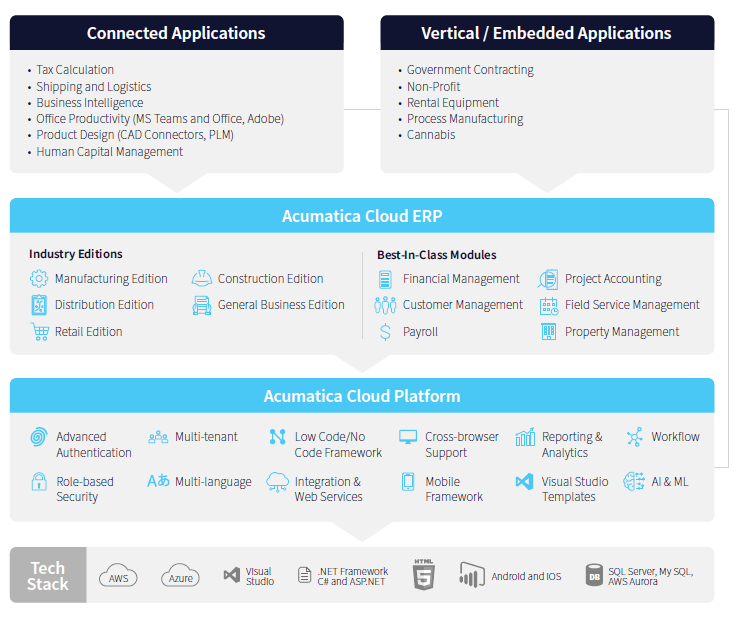
Founded in 2008, Acumatica is an award-winning cloud-based ERP software that provides over 10,000 customers around the world with adaptable and customizable business management solutions. The business management software is sold exclusively through a network of Value-Added Resellers (VARs). Acumatica is recognized for its usability and offers industry-specific editions for:
- General Business
- Manufacturing
- Distribution
- Construction
- Professional Services
- Retail
Key aspects of Acumatica’s platform include:
- Ongoing Innovation: The platform integrates technologies like AI for real-time analytics and reporting.
- Data Ownership: Acumatica’s Customer Bill of Rights states that users own their data and can access it in full, usable formats.
- Security Model: The Acumatica platform provides a comprehensive security framework to protect business data.
- Training: Free and comprehensive online training resources are available to all users.
With its “anytime, anywhere” cloud access, individuals and teams can connect to business data from various locations. The system’s functionality can be extended through third-party applications integrated via open APIs. While designed with small and midsized businesses in mind, some larger enterprises also use Acumatica as their ERP solution.
How Does Acumatica Licensing, Deployment, and Pricing Work?
Acumatica software reviews often highlight its unique pricing model. Simply put, Acumatica’s pricing is based on three factors:
- The applications you choose to implement.
- Your expected transaction volume.
- The licensing and deployment option you select.
Deployment options include:
- Software as a Service (SaaS)
- Private cloud subscription (PCS)
- Private cloud perpetual (PCP)
Customers can switch between these options.
The company website’s ROI Calculator estimates cost savings, productivity gains, and business benefits from implementing a cloud ERP system.
Unlike many ERP providers that use a per-user pricing model, Acumatica’s costs are driven by system usage. This resource-based consumption model means companies can add new users without incurring additional licensing fees, allowing for growth without financial penalties for expanding the workforce. An Acumatica partner provides a cost breakdown before implementation to ensure pricing transparency.
Acumatica Pros: What are the Standout Strengths?
Cloud Accessibility: Offers anytime, anywhere access, eliminating the need for on-premises hardware.
Customization: Highly customizable to fit unique business needs, with flexible dashboards and layouts.
Industry Specialization: Users praise Acumatica’s extensive editions tailored for industries like construction, retail, manufacturing, distribution and more on top of financial management, project accounting, inventory management and other features.
Integration Capabilities: The flexible platform, with its open APIs and REST/SOAP endpoints, also simplifies integration with third-party applications, which is seen as a key benefit for managing growth and improving efficiency.
Automation: Reduces manual input errors and streamlines repetitive tasks.
User-Friendly Interface: Intuitive design that simplifies navigation and onboarding. TrustRadius, a buyer intelligence platform, has awarded Acumatica for being a Top-Rated product, a recognition that stems directly from customer satisfaction.
“Acumatica has made the list consistently by delivering a modern flexible cloud ERP solution that empowers growing businesses,” says TrustRadius Chief Marketing Officer Allyson Havener. “They clearly stand out for their usability and scalability, qualities that their customers value most.”
Scalability: Suitable for growing businesses with increasing operational demands.
Support and Education: Offers free educational resources and certified partners for implementation and support.
Pricing: Reviews of Acumatica often highlight its pricing model, which avoids per-user fees, as a major advantage.
Nucleus Research, a global market research firm, identifies usability as a significant strength. In its 2025 SMB ERP Technology Value Matrix, Nucleus Research ranked Acumatica as a Leader with the highest score in usability. The business software review platform G2 has also consistently recognized Acumatica as a leading ERP, awarding it titles such as Easiest to Use and Highest User Adoption across various categories in 2025.
Acumatica Cons: Where It Requires Extra Effort?
While many users praise Acumatica’s strengths, some have pointed out areas for improvement.
Implementation Complexity: This type of feedback is common for most ERP solutions, as implementations can be complex. Tailoring the software to specific business needs, such as adding custom features or specialized reports, is a technical process that relies heavily on the expertise of the implementation partner.
Integrations: some third-party applications can also present challenges. Complex workflows or unique customization requests can slow down the process, and the timeliness of support from independent software vendors (ISVs) may vary.
Learning curve – Some users have also reported a steep learning curve for some of the advanced, more technical features. However, as one verified user, Adiahaudo E., noted in a G2 review, this has not been a significant deterrent:
“The customization options are powerful, but they can be a bit much if you’re not careful. There’s a lot you can tweak, and it’s easy to go down a rabbit hole fine-tuning every workflow. Also, if you’re coming from an older on-prem setup, there’s a bit of a learning curve to understanding the cloud structure and permissions. Once you get it, though, it runs smooth.”
Performance: Depending on business volume, it can be resource-intensive, impacting performance in environments with limited IT infrastructure.
Acumatica Pros and Cons
| Pros: Empowering Your Growth | Cons: Points to Consider |
| Cloud Accessibility Anytime, anywhere access. Keeps teams connected in the office or the field. | ERP Implementation Complexity Setup can be complicated and may require expert partners. |
| Customization Flexible dashboards and layouts tailored to your needs | Specific Integration Challenges Integrating with some third-party tools can be tricky and take time. |
| Industry Specialization Editions for construction, retail, manufacturing, and more. | Learning Curve Powerful features can take time to learn, especially for new users. |
| Automation Streamlines tasks and reduces manual errors. | Performance Demands Needs good infrastructure; can run slow on limited systems. |
| User-Friendly Interface & Usability Intuitive, easy to navigate, and highly rated for use. | |
| Scalability Grows with your business. | |
| Cost Effective Licensing No per-user fees; pay based on usage. | |
| Support & Community Access free resources and a wide support network. |
What to Expect During Implementation and Integrations?
Implementation and integration projects for any ERP are significant undertakings. It’s important for potential customers to set realistic expectations before committing. Both processes require expert assistance, patience, and time, including dedicated training for key users.
Change management practices are also essential. This involves communicating clearly and frequently about the technology adoption, explaining the reasons for the change and how it will be managed. Securing support from senior executives and team members across all departments is crucial for a successful transition.
Which Organizations are a Good Fit for Acumatica?
Small to mid-market businesses with plans to expand are the primary audience for Acumatica. This includes both single-entity and multi-entity organizations in industries like construction, manufacturing, distribution, professional services, and retail.
Let’s look at some examples:
- Construction firms can use Acumatica for financial management and project control, tracking all project details, job costs, and changes in one system.
- Manufacturing companies can manage production planning, inventory control, and supply chain management on a single platform. The software provides tools for product design, resource planning, and reporting to help improve efficiency.
- Distributors, retailers, and professional services firms can also benefit from centralized inventory management, order processing, planning, and project accounting.
The system’s real-time reporting and customizable dashboards are designed to help businesses make strategic decisions based on current data.
Conclusion: Is Acumatica the Right ERP for Your Needs?
Ultimately, whether Acumatica is the right ERP solution depends on your specific business requirements. Consider the following questions:
- Do you need an ERP system that offers a resource-based pricing model instead of charging per user which limits growth and cross team collaboration?
- Is a solution with flexible deployment options (SaaS, private cloud) important to you?
- Do you require an ERP solution with features tailored to your specific industry?
If you answered “yes” to these questions, Acumatica could be a strong candidate for your business. For more detailed information, it’s recommended to contact us to provide a demonstration and answer questions specific to your organization’s needs.